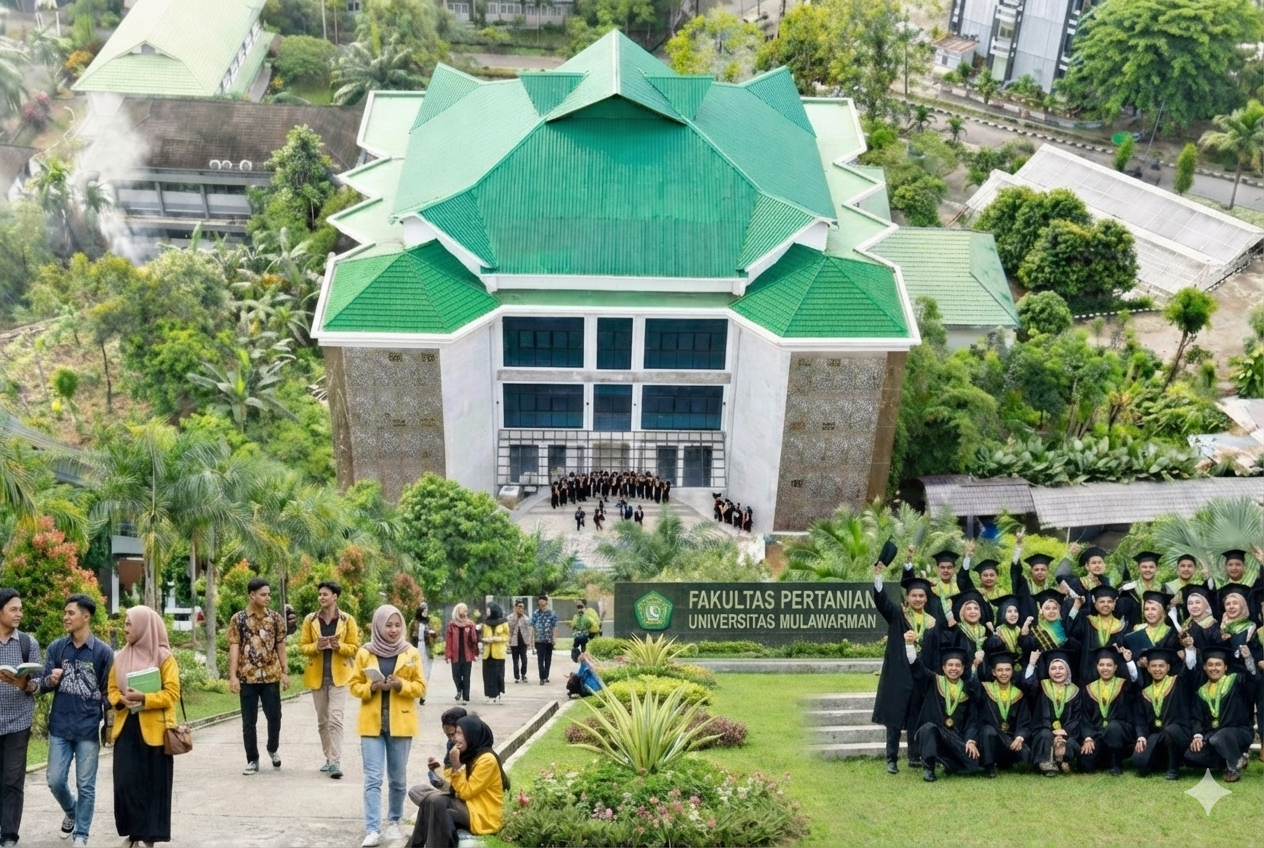
Pioneer of Humid Tropical Agriculture
Established in 1962, the Faculty of Agriculture, Universitas Mulawarman (Faperta Unmul) is a center of excellence in agricultural research and education adapted to Kalimantan's tropical ecosystem. The faculty delivers education from the undergraduate to the doctoral level, with a focus on humid tropical agriculture, sustainable agribusiness, agricultural product technology, and tropical animal husbandry.
Brief History
The Faculty of Agriculture, Universitas Mulawarman was founded on 27 September 1962. In its early days, the faculty was still joined under one roof with the Faculty of Forestry.
Responding to the need for disciplinary specialization, in 1967 Faperta was officially established as an independent faculty and has continued to develop into a leading institution in ensuring food sovereignty and the development of humid tropical agriculture.
Direction of Development
Faperta Unmul strengthens its role as a reference for humid tropical agriculture, including supporting the development of the Nusantara Capital City (IKN) through research, the downstream processing of agricultural products, and national as well as international cooperation.
Development is directed toward strengthening academic quality, achieving excellent accreditation, as well as making real contributions to the community and the business world.
Study Programs
Faperta Unmul delivers eight study programs from the undergraduate, master's, to the doctoral level.
Agroecotechnology
Undergraduate (S1) · Accreditation B
Combines Agronomy, Soil Science, and Plant Pests and Diseases to manage crop production systems that are adaptive to the humid tropical ecosystem.
Agribusiness
Undergraduate (S1) · Accreditation B
Studies farm business management, supply chains, marketing, as well as agricultural policy and communication to realize a competitive agribusiness.
Agricultural Product Technology
Undergraduate (S1) · Accreditation A
Focuses on the processing of agricultural products, food safety, and the development of innovative products based on Kalimantan's local resources.
Animal Science
Undergraduate (S1) · Accredited by BAN-PT
Develops efficient and sustainable tropical animal husbandry systems, oriented toward animal welfare as well as animal-based food security.
Agricultural Extension
Undergraduate (S1)
Produces competent and innovative graduates in the development of sustainable agriculture as well as community empowerment.
Master of Humid Tropical Agriculture
Master's (S2)
Strengthens tropical agricultural research capacity across the aspects of production, protection, as well as policy and resource management.
Master of Food and Agricultural Product Technology
Master's (S2)
Prepares outstanding graduates in the field of food and agricultural product technology as academics, industry professionals, bureaucrats, as well as entrepreneurs.
Doctor of Agricultural Science
Doctoral (S3)
Prepares researchers, academics, and policymakers who lead the development of humid tropical agricultural science and technology.
Vision and Mission
Vision
"To become an internationally standardized Faculty of Agriculture that excels in the development of humid tropical agricultural science and technology and contributes to sustainable development."
Main Mission
- To deliver high-quality, research-based agricultural higher education.
- To develop innovative research in the field of tropical agriculture that is globally competitive.
- To carry out community service for empowerment and food self-sufficiency.
- To build networks of cooperation with the government, industry, and international institutions.